Fee Settings

This topic details all the settings for fees. This is the information you will need when you add or edit fees.

Service Design Center uses a change management process to track and approve all changes to any product. All of these changes, including additions, edits, and deletions, must go through the promote-approve-deploy process before they become available.

Any changes you make (change a name, change a price, add or delete a product from a bundle, etc.) to any product do not affect any users that already have the product.

General Tab


Appearance Settings

These settings define how information about a product will appear to customers.

Setting Description
Name Required. The name serves 2 primary purposes: it's what you see in product lists and it's what customers see as a descriptor when they are making purchase decisions. The name is limited to 115 characters.
Short Description Brief plain-text information about the fee that sometimes appears with the fee name. 
Description Detailed and descriptive rich-text information about the fee that appears on fee detail pages. You can format the content you enter in several different ways using the functions in the toolbar.
Fulfillment Type

Required. This defines the system process by which customers receive the product or fee.

Currently, ItsOn Digital Delivery is the only option that is supported. Selecting any other option may produce unpredictable results.

Recipient/Sharing/Assigning Settings

These settings determine who can be charged for the fee.

Setting Description
Customer can buy for

Required. Fees cannot be gifted. So there is only one option:

  • Customer's account only - If you want the fee to be charged to the purchaser's account.

Behavior Settings

These settings determine how and when a fee is available.

Several of the behavior settings relate to aspects of the fee cycle, aspects that include:

Setting Description
Number of Cycles

Required. This defines the number of cycles a subscriber can receive the fee. The options determine if a fee repeats at the end of its duration. (The duration is defined either as the account cycle, if Aligned to account cycle is Yes, or as the fee's Cycle Duration value.) If so, the customer is grandfathered the fee rate and attributes when it is renewed. Select from:

  • Unlimited: Subscribers can continue to be charged the fee until they unjoin or the account is terminated.
  • Limited to: Enter the number of cycles that the fee can be charged.

    You can enter only positive integers (1, 37, 5287024, etc.) in this field. Zero, negative numbers, and decimal numbers (0, 0.5, 3.1415926, 2.5, etc.) are not allowed.

Fees renew when they are set to an unlimited number of cycles or when they are "limited" to more than one cycle, that is, the number in the Limited to option is greater than 1. Renewing means that at the end of a fee cycle's duration:

  • The cycle starts over.
  • Billing occurs.
Fee Type

Required. Determines the entity to which the fee is associated. Select from:

  • Account Fee - When the fee is assessed, it is charged to the account. The fee can be assessed as long as the account is active (including when the account is suspended). The fee is removed only when the account is deactivated or the Number of Cycles is exhausted.
  • Subscriber Fee - When the fee is assessed, it is charged to the account per subscriber on the account. The fee can be assessed as long as the subscriber is joined to the account (including when the subscriber is suspended). The fee is removed only when the subscriber is unjoined or the Number of Cycles is exhausted.
Aligned to account cycle Required. This is the alignment, and it defines when renewals occur and are billed. Available only when Number of Cycles is set to Unlimited or set to Limited to and its value is greater than 1. Defines whether the fee is billed when the account cycles or when the fee is initially charged.
Cycle Duration

Required. This defines how long a fee cycle is. Available only when Aligned to account cycle is set to No. Select from:

  • Unlimited. This would be the same as selecting Limited to and entering 1 in Number of Cycles and would mean that the fee is assessed only once. If selected when Unlimited is selected in Number of Cycles or if the Limited to value in Number of Cycles is greater than 1, will generate an error.
  • Lasts, then enter a number and select a unit of measure from minute(s), hour(s), week(s), day(s), or month(s) (default). This sets the time period between fee assessments.

You can enter only positive integers (1, 37, 5287024, etc.) in this field. Zero, negative numbers, and decimal numbers (0, 0.5, 3.1415926, 2.5, etc.) are not allowed.
Prorated on first cycle

Required. This is proration, This is proration, and it defines how much of the fee is billed for the first cycle. Available only when Aligned to account cycle is set to Yes.

Usage Display

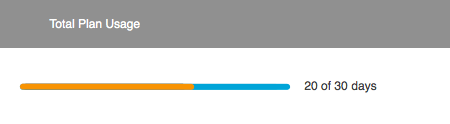
For fees, there is no "usage," only possible duration. This setting for fees determines whether or not fee duration information will be visible. Select:

  • Custom: To select what type of duration data your subscribers will see for this fee.
  • Default: To use the default usage display property, which shows fee duration.

Custom Usage Display Options Choices

Usage Display Property Definition Example
Duration

Shows the amount of time used and the total time available.

Default for fees with limited duration.

None

Shows the fee name only.

Default for fees with unlimited duration.

Visibility

Determines whether on not the fee is visible to customers.

If this is set to No, the fee is not visible in a customer's account information. It is not shown as part of a bundle when included in a bundle.

A fee cannot be hidden unless its price is equal to 0 (zero). This is because at checkout, a non-zero priced fee in the cart will result in a total price that is different from the sum of the prices of the visible products, which could cause customer confusion. So this setting is unavailable until a price value greater than 0 (zero) has been entered for the fee.

Billing Settings

Setting Description
Retail Price Defines the default, standard price for the product (plan, fee, or bundle). This is the price customers will see unless overridden by the Sale Price field or other available offer mechanisms. If no value is entered, 0 is used.
Sale Price

Overrides the Retail Price while allowing you to keep a record of the retail price. To return to the Retail Price, delete the contents of this field.

A Sale Price can affect whether customers qualify for offers (benefits and discounts), depending on the value of the Apply to sale price setting in the offer.
Tax Classification

This defines what specific taxes should be charged, if at all. Different municipalities and other political units charge varying amounts of and types of taxes and fees on specific types of goods and services. This selection drives the correct type and amount of taxes to be collected based on the customer's location and type of service purchased. Select from:

  • Data Plan
  • Voice Plan
  • Text Plan
  • Line-Based Fees
  • Equipment
  • Not Taxable